mandag den 26. december 2016

144 MHz EME - Making 2 rotators play together

My EME-project is progressing nicely. One of the tasks is to make the azimuth and elevation rotors "play together" - that is tracking the Moon. My main software for JT65B EME will be WSJT by Joe Taylor, K1JT. WSJT takes care of the communication protocol, but it cannot control the rotators directly. You need different software for this.

PSTRotator is clever software made by YO3DMU. Its main purpose is controlling antenna rotators, but a Moon tracking facility is also available.

PSTRotator controls the antenna's azimuth and elevation.

Nr. 1. This window displays Moon data. 
Nr. 2. This is the PSTRotator main window.
Nr. 3 is an USB-to-RS232 converter.
Nr. 4 is the rotator controller ERC-3D. PSTRotator sends commands to this box.
Nr. 5a and 5b are rotator control boxes. They control the rotator and supply power to it.
Nr. 6a is the azimuth rotator (Yaesu G-600).
Nr. 6b is the elevation rotator (Kenpro KR-550).

PSTRotator is shareware - you can try it for free, but you pay 20 EUR if used permanently.

Regards from OZ1BXM Lars Petersen
Homepage: oz1bxm.dk

mandag den 7. november 2016

ATF - a Danish ham radio rally

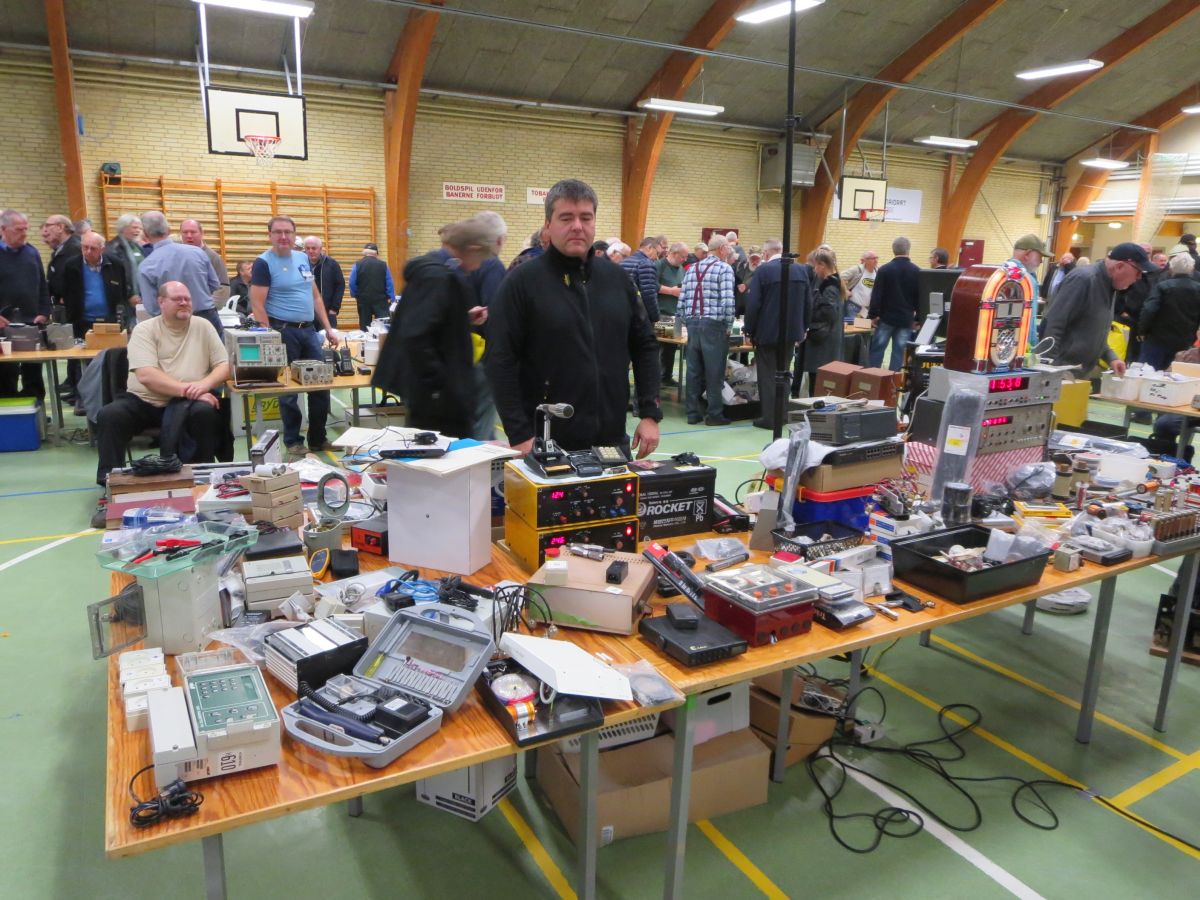
I visited a ham radio rally (the name is ATF) in Odense in November. The town of Odense is situated on the island of Fyn. This town is often used for meetings and conferences, because it is in the center of Denmark. People from Jylland (western part of the country) and Sjælland (eastern part of Denmark including Copenhagen) can drive there within a few hours.

This rally is held annually and it is quite popular among radio amateurs in Denmark. The stuff on display and for sale belongs to the category "general ham radio". Other rallies are more focusing on special branches of our hobby, for example VHF/UHF/Microwave.

There are several attractions when attending a ham radio rally:
  • You can purchase equipment, both home-made and factory-made
  • You can buy all the spare parts and cables you need
  • You can listen to lectures on different subjects
  • You can meet old friends and make new ones
  • You can visit boots manned by specialists (e.g. "50 MHz")

ATF in Odense 2016-11-06.
The picture above shows the crowd in the morning. Everyone is busy checking the offerings on the tables!

Vy 73 from OZ1BXM Lars Petersen
Homepage: http://oz1bxm.dk

tirsdag den 1. november 2016

WSPR on 30 meters - my findings

I let WSPR run on 30 meters during 13 days of October 2016. The purpose was to learn how my antenna performed on 10 MHz.

My antenna is a loop skywire: 43 meters of wire shaped as a rectangle. The antenna configuration is shown below:

My loop skywire antenna.
The WSPR results were not as expected. I hoped to hear more continents. The average number of continents heard per day was 2.2. Not impresssive. I would have expected hearing at least 3 continents each day. 
Continents heard with WSPR on 30 meters (October 2016).
When I compare the results for 30 meters with those of the 40 m band, it is clear that this antenna performs better on 40 meters. 

OZ1BXM Lars Petersen
Homepage: oz1bxm.dk

onsdag den 5. oktober 2016

WSPR on 30 meters

I had my first experience with WSPR in 2009 and I wrote a piece about WSPR on my blog. Three months later, I published another piece: Reaching worldwide with WSPR. Then I moved on to JT65 in order to make real QSO's on the HF-bands. As you know, a WSPR contact does not count as a QSO.

I have been little active on 30 meters (less than 100 contacts), so I've decided to run WSPR on this band. The purpose is to learn how my antenna (loop skywire, 42 m of wire shaped as a rectangle) performs on 10 MHz.

My experiment begins on October 8th, 2016 and is planned to run until the end of the month.

OZ1BXM Lars Petersen
My homepage: oz1bxm.dk

lørdag den 27. august 2016

Code Practice Oscillator

The Code Practice Oscillator pictured below was developed by me. It is simple and easy to build. It is based on the 555 oscillator IC and is powered from a standard 9V battery. The loudspeaker is mounted on a separate PCB and the two boards are connected with metal spacers. The whole assembly requires no cabinet - and that reduces building time!


Homemade Code Practice Oscillator
Training morse code reception is pretty much covered already by the aid of hardware-based morse trainers, PC programs, app's for smart phones and tablets, etc.

Sending morse code is another case. The obvious solution is to use a keyboard and let the software do the job. This solution works, but you will be missing the touch and feel of dots, dashes, and spacing provided by a manual key. I would recommend a novice sending morse code using a real morse key, and move on to more advanced devices and higher speeds at a later time. 
Circuit Diagram
Another benefit of building your own Code Practice Oscillator is the proudness gained from a successful project. Building skills like reading a diagram, soldering components, connecting wires, and mounting a loudspeaker are all learned during this project.

Best regards: OZ1BXM Lars Petersen
Homepage: http://oz1bxm.dk

mandag den 6. juni 2016

How addictive is DXing?

I watched a movie yesterday on Danish television: The Big Year from 2011 starring Steve Martin, Jack Black, and Owen Wilson. Two bird enthusiasts try to defeat the cocky world record holder in a year-long bird-spotting competition. Bird-spotting is about seeing (or hearing) a specific bird species, and writing down the day, time, and location in a log.

The Big Year.
The reason for watching this fine movie was the analogy between the behavior of bird-spotting enthusiasts and ham radio operators, especially DXers. It is a well-known fact in our circles, that DXing can be an obsession to people, and it has the potential of becoming "the meaning of life" - at least for a long time.

A Year of DX.
The Big Year competition for bird-spotters runs from January 1st to December 31th. It is similar to the DX Marathon. The idea of comparing bird-spotters with DXers is not mine. I read it in A Year of DX by Bob Locher, W9KNI.

Regards from OZ1BXM Lars Petersen
Homepage: oz1bxm.dk

mandag den 2. maj 2016

How JT65 surprised me

I've had a strange experience with my HF-antenna. Here follows the story:

Something was wrong with my antenna. I could not achieve the QSOs I was used to. I called people, but they did not answer. Listening was normal, but transmitting suffered. What was wrong?

My HF-antenna is a horizontal wire loop. I measured the resistance of the loop. It was 1.2 ohm as usual. Then my suspicion turned to the ATU which was sitting outdoors under the roof. Could corrosion have harmed the relays? Was there a bad component on the balun PCB?

I took the ATU down and measured the attenuation from input to output using 20 W RF.
  • 3.5-14 MHz close to 0 dB
  • 18 MHz about 0.5 dB
  • 21-28 MHz about 0.7 dB      
The attenuation figures above are normal. The problem was not the ATU.

The balun was the next object to investigate. I discovered that a screw had become loose. It was the screw securing the wire from the balun output to the antenna terminal. The antenna was thus galvanically disconnected from the balun because this particular screw had gone loose! Here was the explanation of the mysterious lack of contacts! Although galvanically disconnected, there was still a small capacitance between the balun terminal and the antenne wire. I estimated this capacitance to be 1 pF or less.
No connection between balun and antenna.
Before I started the repair job, I had three QSOs with the faulty antenna:
  • RA0AUC, 20m, my signal -22 dB, JT9
  • LU8HGI, 15 m, my signal -20 dB, JT65
  • RN6HGN, 15 m, -25 dB, JT9
The missing antenna connection reduced my power from 5 W to about 50-100 mW (estimated). And the 3 QSOs above were all run with that low power! I find that amazing and a tribute to the digital protocols JT65 and JT9, which were both invented by Joe Taylor, K1JT.

Regards from OZ1BXM Lars Petersen
Homepage: oz1bxm.dk