søndag den 31. august 2014

Wireless internet access

A ham operator needs connecting to the internet when travelling or operating outside his QTH. But why does a ham operator need internet access?
  • Download DX information, e.g. from DX Summit
  • Upload log files, e.g. to Clublog
  • Upload contacts to eQSL and LotW
  • Synchronize PC-clock with NTP server (when running JT65 modes)
To enable mobile internet access, I've purchased a Huawei Mobile Broadband USB surfstick (see picture below). The USB surfstick contains a 2G/3G modem. The modem is only used for data transport, not for speech. This device enables internet access in most locations in Denmark.

Huawei E3531 Mobile Broadband modem with SIM card (top cover removed).
Installation is super easy. Just plug the surfstick into your Windows 7 PC and wait for the drivers to install. The surfstick has a local homepage, where you can follow data sent and received, and monitor the signal strength. 

My operator is OiSTER and they utilize the mobile network owned by 3 Denmark. Roaming is not allowed. 

OZ1BXM Lars Petersen
Homepage: oz1bxm.dk

tirsdag den 10. juni 2014

Vacation

Time for vacation! I'll return to this blog with new contributions in September. Until then: Have a nice vacation, all of you!


73 from OZ1BXM Lars Petersen
Homepage: oz1bxm.dk

fredag den 4. april 2014

Stable LO for 23 cm, Multiplier

The task of the EME1152-MLT multiplier is to double the 576 MHz signal generated by the EME175 oscillator. The result is a clean 1152 MHz signal at +16 dBm, which is attenuated to +7dBm and fed to the DBM (mixer) in the 23 cm converter.

The first stage in the multiplier is the GALI-39. It generates several strong harmonics of 576 MHz. Next stage is a tunable filter, which selects the 2. harmonic (1152 MHz) and suppress other frequencies. The two variable capacitors in the tunable filter can be seen near the center of the PCB. Last stage is a GALI-6 which amplifies the desired signal and provides +16 dBm output.

The finished EME1152-MLT print. 

Working with SMD components is difficult in the beginning. But "practice makes perfect" and you get used to the small parts and small distances. I really like to assemble SMD projects, but you need the right tools for the job. A temperature controlled soldering iron with replacable tips; some thin soldering wire (0.5 mm diameter); and a magnifying glass are necessary tools. You will also need a wooden tooth-pic for securing the component while soldering it the first time.

73 from OZ1BXM Lars Petersen
Homepage: oz1bxm.dk

søndag den 9. marts 2014

Stable LO for 23 cm

I have started building a stable Local Oscillator (LO) for my 23 cm transceiver. The LO consists of two parts:

  • Crystal oscillator for 576 MHz   
  • Multiplier for 1152 MHz 

I'll build both modules from kits sold by Mini-Kits in Australia. This company has reasonable prices, and shipping via air from Adelaide to Holstebro, Denmark took only 5 days!  The oscillator kit has number EME175 (I ordered the 400-600 MHz version). The multiplier kit has number EME1152-MLT. Both kits are high-quality products and they are not intended for the new ham - SMD soldering is required!

Crystal oscillator - EME175

In the picture above, you can see an oscillator heater on the left side next to the 96 MHz crystal. The oscillator heater keeps the crystal temperature constantly at 60 degrees centigrade. The heater has number EME177 and uses only 60 mA after warm-up. 

73 from OZ1BXM Lars Petersen


lørdag den 1. februar 2014

WinKeyer, part 1

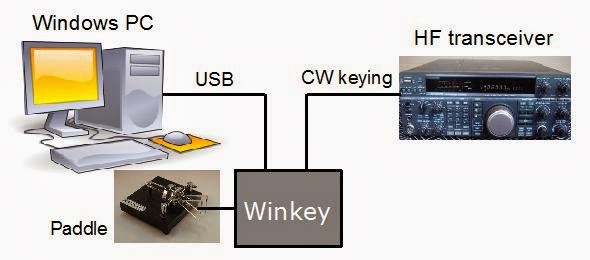
The WinKeyer principle is shown in the picture below. Both computer generated morse and manually generated morse is sent to the WinKeyer, and the WinKey device will key the transceiver.


PC and paddles are connected to the transceiver via WinKeyer. 

You may ask: Why not let the computer do the work? What is the benefit of the WinKeyer?

Firstly, the WinKeyer has become the "de-facto standard" for CW transmission in computer software. Many logging programs, contest programs, and digital mode programs support the WinKeyer protocol. This makes switching between different programs easy. You simply set the new software for the WinKey protocol, and off you go with CW!

The second benefit is flexibility. The TX macros will probably be executed via the computer software. But supplementary text can be sent anytime using the paddles. The speed button on the front of the WinKeyer can immediately change the pace of characters. No batteries are necessary since power is drawn from the computer via the USB  interface.

I ordered a Winkeyer kit from Hamcrafters (formerly K1EL Electronic kits) some weeks ago. The kit is expected to arrive soon. I can hopefully tell you more next month!

OZ1BXM Lars Petersen

Homepage: http://oz1bxm.dk

onsdag den 1. januar 2014

New Year resolution: QRP DXCC

Year 2014 is here, and it's time  for New Year resolutions. My personal resolution in ham radio is to obtain the QRP DXCC award from ARRL. My current status is 83 entities; working 17 more using 5 W or less will put QRP DXCC under my belt!

QRP DXCC rules from the ARRL homepage.

This award is a one-time award - the traditional DXCC program, where you can work your way up to honor roll, is far more popular. But if you love low power operating, QRP DXCC is worth pursuing. According to ARRL, about 550 people have earned it so far and only one is from OZ.

The QRP DXCC application process is quite simple: You submit a list of worked entities (QSL-cards are not submitted) and a declaration that all contacts were made using 5 W og less. That is it. You can read what other hams think of this diploma in Product reviews at eham.net.

OZ1BXM Lars Petersen

A Tiny QRP Page by OZ1BXM

lørdag den 7. december 2013

New QRP Club

I received a mail containing an invitation to join QRP Club last week. The club's main activity is running a forum for QRP'ers. I liked the idea and decided to join (you have to register, and await approval by the admin).


The forum already contain many presentations. Here is mine:
Hello fellow members!
I have worked QRP for many years now, actually since 1985. 
I worked as a secondary school teacher in Greenland 1985-88, and held the call OX3XM. During that time, I worked approx. 500 QSO with 20W (almost real QRP...). It was easy to get contacts in cw, even though my signal was weak.
I work mostly cw and JT65 today, and QRP still fascinates me. My next goal is QRP DXCC.
72 from OZ1BXM Lars
Best wishes for a Merry Christmas, and a Happy new Year!

OZ1BXM Lars Petersen

A Tiny QRP Page by OZ1BXM