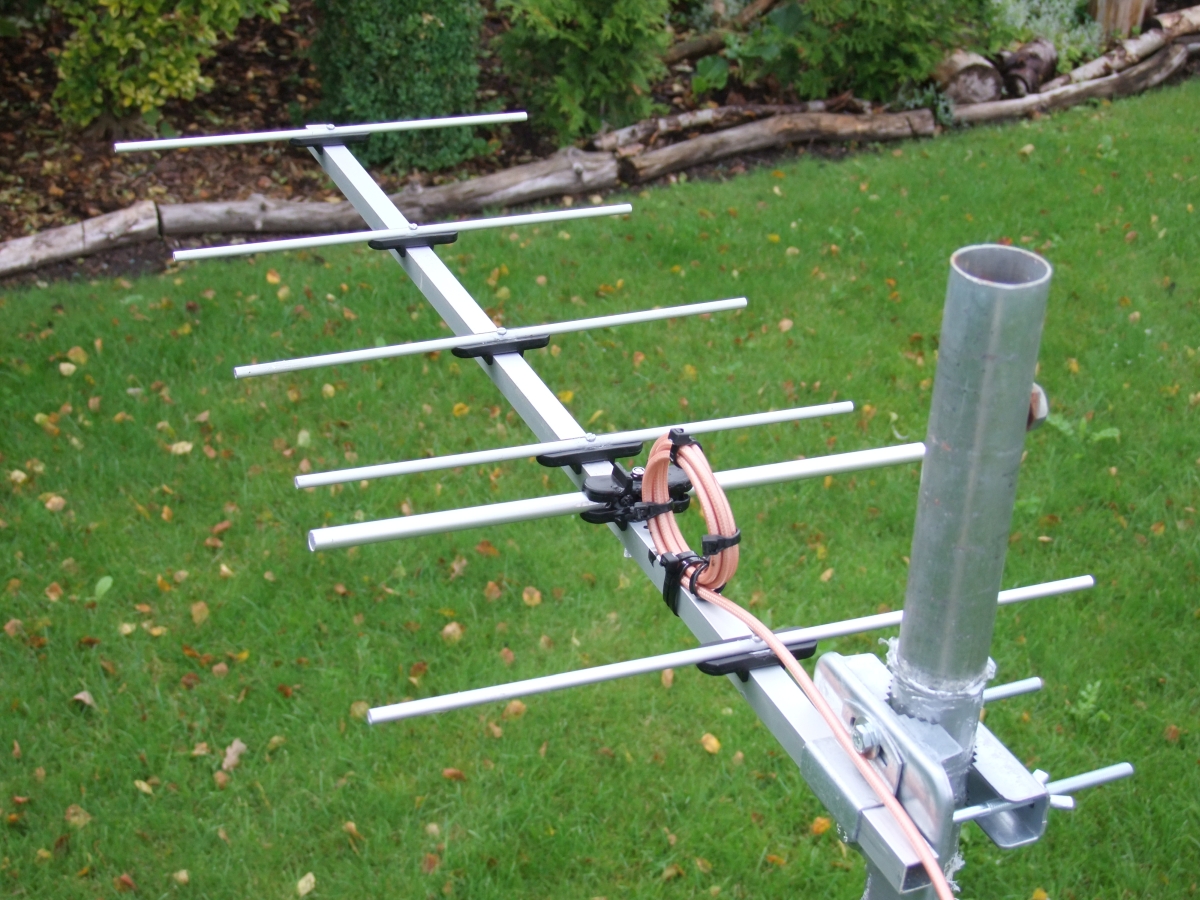
| Figure 1. T2LT antenna for 28 MHz. |
![]() |
| Figure 2. Coax cable coil. |
![]() |
| Figure 3. The antenna is mounted vertically. |
![]() |
| Figure 4. My WSPR signal reached four continents. |
| Figure 1. T2LT antenna for 28 MHz. |
![]() |
| Figure 2. Coax cable coil. |
![]() |
| Figure 3. The antenna is mounted vertically. |
![]() |
| Figure 4. My WSPR signal reached four continents. |
My latest diplomas (DXCC, QRP DXCC) were important milestones for me. My next goal is to reach 150 DXCC entities, which will be marked by an endorsement sticker. Endorsements are available for the DXCC diploma, not for QRP DXCC. There are endorsements when reaching 150, 200, 250, 275, 300, 305, 310 entities, and so on in steps of 5.
Collecting entities
I've worked 165 entities as of today, but only 133 are confirmed. I'll continue to work new entities when I can. This includes DX-peditions, contests and the random QSO. Unconfirmed entities will be worked again.
Collecting confirmations
Falkland Islands QSL received after 14 years
My first DXCC was acquired in 2023. My second DXCC was received in the mail today. It is QRP DXCC, which requires all contacts be made with max. 5 W at my end. About 80% of the contacts were made with CW, and the remaining with FT8.
This RS-232 probe is useful when troubleshooting a serial connection. It provides an optical indication of the line state and traffic on the line.
RS-232 has two states: +3 to +15 volt (logic 0, space) or -3 to -15 volt (logic 1, mark). The RS-232 probe displays the two states using LEDs, and you can see the states changing. The maximum baud rate on the line is 9600 baud. At faster speeds, you cannot see the LEDs flashing.
The bit length in a 9600 baud signal is 104 microseconds, and with 10 bits being sent, the flashing will last about 1 milliseconds. The flashing can be detected by the naked eye.
Please refer to figure 1. If the input of the probe is higher than 2.7 volt, the red LED is on (green LED is off). If the input is lower than -2.7 volt, the green LED is on (red LED is off).
The RS-232 probe is powered by two 9 volt batteries. The current consumption is low, and the batteries can last for a long time. Don't forget to disconnect the batteries when the probe is not used.
Figure 2. Veroboard.
All components are fitted on a piece of Veroboard. This is my preferred way of building electronic circuits! The dent on LED1 faces away from T1. The dent on LED2 faces T2.
Best 73 from OZ1BXM Lars
My homepage: oz1bxm.dk
This TTL probe is helpful when troubleshooting a serial connection. It provides an optical indication of the line state and traffic on the line.
The bit length in a 9600 baud signal is 104 microseconds, and with 10 bits being sent, the flashing will last about 1 milliseconds. The flashing can be detected by the naked eye.
Figure 1. Circuit diagram.
If the input of the probe is between 0 V and 2 V, the green LED is on (red LED off). If the input is between 3 volt and 5 volt, the red LED is on (green LED off).
The TTL probe is powered by 5 volt DC. This voltage can be taken from the measured circuit, or from a external PSU. Even a 4.5 volt battery can be used.
Figure 2. Veroboard.
All 8 components are fitted on a piece of Veroboard. This is my preferred way of building electronic circuits! The dent on LED1 faces away from T1. The dent on LED2 faces T2.
The circuit was copied from DIY Logic Probe: Step by Step Guide.
Best 73 from OZ1BXM Lars
My homepage: oz1bxm.dk
ADX-S stands for Arduino Digital Transceiver - Superheterodyn. ADX-S is a QRP transceiver with four modes: WSPR, FT8, FT4 and JS8. There are two versions available; one with 4 bands (40m, 20m, 15m, 10m) and another one with 7 bands (40m, 30m, 20m, 17m, 15m, 12m, 10m).
ADX-S is open source. I decided to build it from a 7-band kit sold by crkits.com. Help is available in the crkits group.
The ADX-S transceiver has 3 PCB with the same size: front plate, main board, rear plate. They all measure 9.7 cm x 9.7 cm. All components and connectors are on the main board. The front and rear plates are "sandwiched" to the main board using threaded distance bolts. This is a smart solution to the cabinet problem (cabinets for ham radio projects are difficult to source).
Assembly
Kit assembly went okay with one exception: I swapped L1 and L3 on some of the low-pass filter boards. This error made the output power disappear. After correcting the error, the low-pass filters worked just fine. The output is 2-3 watt RF depending on the chosen band.
The assembly challenge is medium. The solder pads are close and their size is small - this is not a beginner's task! An advantage of the kit is the lack of SMD-components. All components are leaded. Two units (Arduino Nano, SI5351) are populated with SMD, but they are assembled in a factory and are easily soldered to the main board using pins.
Transmitter
The transmitter is surprisingly simple. The ordinary concept is to employ a DBM (double balanced mixer) and LO to get from AF to the transmit frequency. Instead, the transmit frequency is generated directly by the programmable SI5351. The output from SI5351 is amplified and sent to 3 transistors connected in paralled (3 x BS170 MOSFET). The LPF (low pass filter) is on a small PCB which is connected to the main bord with pins. The LPF is specific for each band, and is swapped when changing band.
Connecting to a computer
Figure 5 shows how the ADX-S is connected to a computer. Computer software is WSJT-X (free) and this software codes and decodes FT8, FT4, and WSPR. Different software is used for JT8.
An Android smartphone can replace the computer. In that case the app FT8CN is installed.
73 from OZ1BXM Lars
My homepage: www.oz1bxm.dk
Figure 1.
I needed a short 70 cm yagi for working the LEO satellites. In earlier years, I've had a 6-element yagi and I was satisfied with its performance. So I decided to build such an antenna.
The antenna measurements came from ON6MU. However, I made my own drawing (figure 2). All elements and the dipole were made according to the recommendations by ON6MU. Only the boom is a bit slimmer (15 x 15 mm instead of 20 x 20 mm). I had the tubes and the boom lying around, and assembly was easy. The measurements must be accurate down to the millimeter - and that was a challenge!
The black element holders were found in the scrap-box. They were acquired some years ago from hfkits.com (link: Yagi element holder for 15x15 mm boom - HF kits). The balun is copied from innovantennas - they use the same concept. 4-5 tight loops of coax-cable prevents HF-currents running on the outside of the cable. I used 150 cm RG-400 teflon coax, and it was terminated with an N-connector. Figure 3 shows the balun before it was made water-proof.
Figure 4.
Figure 4 shows how the dipole is mounted on the boom using 2 element holders. The dipole is isolated from the boom. The coax-cable center conductor is soldered to the left solder lug; and the coax braid to the right one.
I did not use stainless screws and mutters for assembly, so I painted all screws/mutters after fitting them to avoid corrosion. Where the coax-cable is connected to the dipole, the cable was secured against moisture. I used PlastiDip for this purpose. Otherwise, the braid may detoriate due to water ingress.
The antenna was mounted on a 1½" steel mast turned by a rotator (Yaesu G-600). From 7.5 meters above ground, the antenna heard two terrestical UHF beacons: OZ7IGY at 227 km (weak signal) and LA8UHF at 322 km (normal signal). I listened for the LEO satellite RS-44, and its beacon was heard at a distance of 4000 km. The antenna works to my satisfaction, and I'll use it from now on!
Antenna SWR is 1.3 between 432-438 MHz, and this figure is satisfactory.